
The best event apps in 2026: how to choose yours
A good event app is no longer an agenda on your phone. In 2026 it's where networking happens, where sponsors measure their return and where organisers get the data to sell the next edition. This guide helps you choose wisely.
Published on · Updated on

Quick answer
The best event app is the one your attendees actually use, and that brings networking, agenda, access and data together on one platform. To choose it, assess five points: adoption and ease of use, matchmaking quality, lead capture for sponsors, real-time analytics, and GDPR compliance and data security.
What is an event app?
An event app is a mobile and web application that supports attendees, speakers, sponsors and organisers before, during and after an event. It brings together the agenda, attendee profiles, messaging, meetings, QR access and analytics in one place.
The difference from an event website is interaction: the app knows who each person is, what they're interested in and who they should talk to. That's why the best event apps have gone from informing to generating business opportunities.

Types of event apps
- Agenda and information apps: programme, speakers, maps and notifications. Useful, but with little business impact.
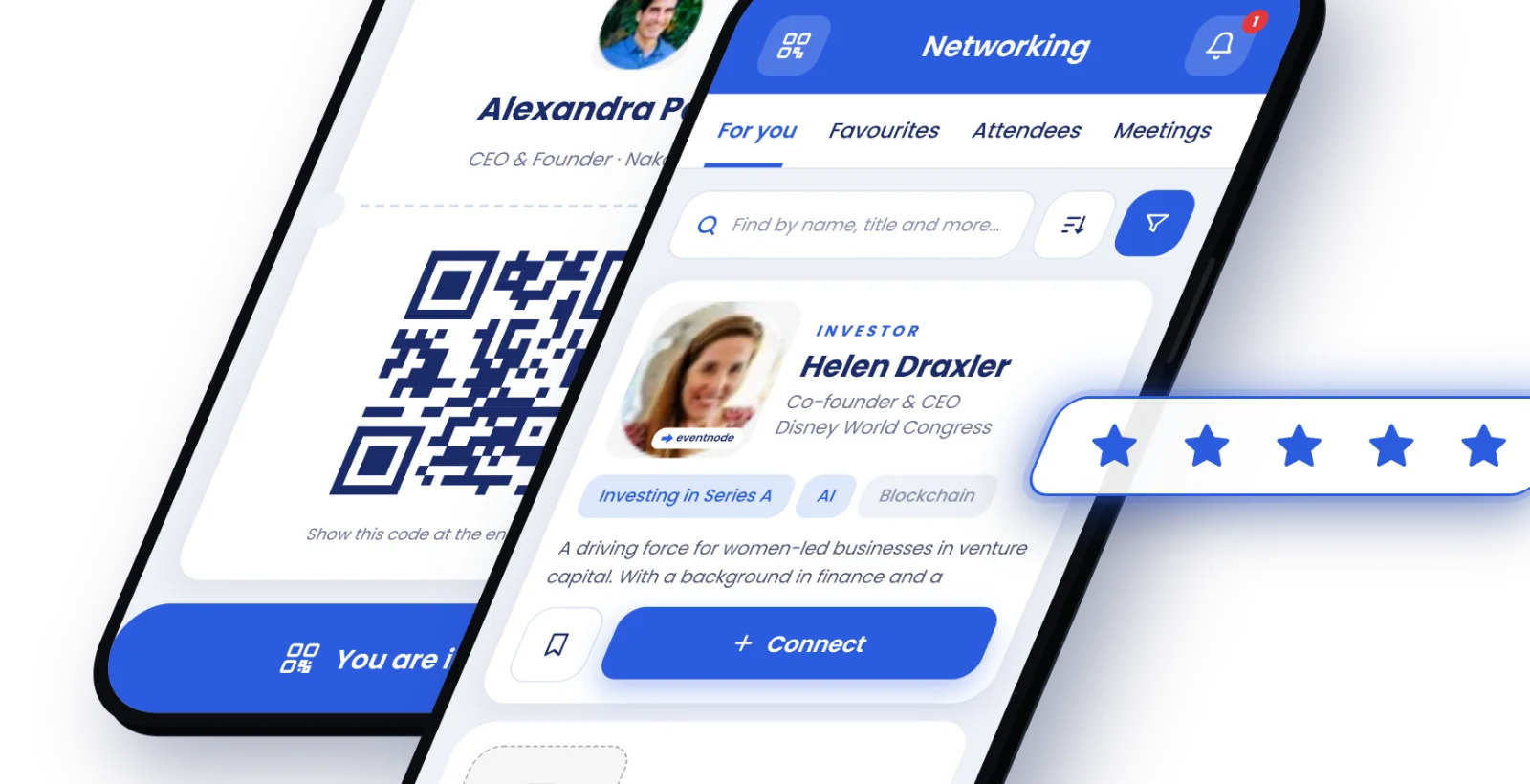
- Event networking apps: profiles, matchmaking, chat and meeting booking. They add the most value at B2B events. We go deeper into what a networking app is and how to measure its ROI.
- Event management platforms: registration, ticketing, access control, role-based permissions and analytics for the organising team.
- All-in-one platforms: combine the three above. This is the category Eventnode belongs to.
Must-have features in 2026
These are the features that make the difference between an app that gets downloaded and an app that gets used:
| Feature | What it's for | Who benefits |
|---|---|---|
| AI matchmaking | Recommends the most relevant people to each attendee based on their goals | Attendees and sponsors |
| Meeting booking | Schedules meetings with a confirmed time and place | Attendees and exhibitors |
| Lead scanning | Captures contacts with a QR code and qualifies them instantly | Sponsors and exhibitors |
| Access control and ticketing | QR check-in, role-based permissions and capacity limits | Organiser |
| Meeting locations | Areas and tables with availability; they can be monetised | Organiser |
| Meeting ratings | Measures the real quality of networking | Organiser and sponsors |
| Real-time analytics | Engagement, meetings, leads and ROI per sponsor | Everyone |
| Security and GDPR | Data protection, consent and access control | Everyone |

How to choose the best app for your event
1. Adoption: if they don't use it, it doesn't exist
Ask to see the full sign-in flow on a phone. The fewer steps between the invitation and the first recommended contact, the more active attendees you'll have. Also check whether it works as a native app and on the web.
2. Networking quality
An attendee list with filters isn't enough. Ask how recommendations are calculated, whether they can be customised by profile type (investor, startup, buyer, exhibitor) and whether meetings held are measured, not just those requested. We explain it in depth in AI matchmaking at conferences.
3. Return for sponsors
Sponsors renew when they can prove results. Look for lead scanning, visibility spaces inside the app and per-sponsor reports.
4. Data and analytics
The organiser dashboard should show in real time how many attendees are active, how many meetings have been booked and how they're rated. That data is your best sales argument for the next edition.
5. Security and compliance
You'll be handling the personal data of hundreds or thousands of professionals. Require GDPR compliance, role-based access control and data hosted in the EU. More details on our security.
Questions to ask the vendor
- What percentage of attendees usually activate their profile at events similar to mine?
- How does the matchmaking work and what data does it use?
- Can I create meeting areas and sell them to sponsors?
- What reports does each sponsor receive after the event?
- Where is the data hosted and which security certifications do you have?
- What support do you offer live, during the event?
Common mistakes when choosing an event app
- Choosing by number of features. Ten features nobody uses are worth less than three that everyone uses.
- Launching it on the day of the event. Networking starts earlier: open the app at least two weeks before so people can book meetings.
- Not measuring. Without meeting and lead data you can't defend the budget or raise sponsorship prices.
- Forgetting the exhibitor. If the sponsor doesn't see results, they don't come back.
Conclusion
In 2026, the best event app is the one that turns attendance into business: it connects the right people, makes it easy for them to meet and gives you the data to prove it. If you organise congresses, trade shows or corporate conferences, start with networking and build everything else around it.
FAQ
Which app is best for organising corporate events?
The one that combines AI networking, meetings, lead scanning, access control and analytics on one platform, and that your attendees adopt easily. Eventnode is designed precisely for B2B corporate events.
How much does an event app cost?
It depends on the model: per event, per number of attendees or an annual subscription for recurring organisers. The number of attendees, features and level of support all play a part.
How far in advance should I launch the app?
Ideally, open it two to four weeks before the event so attendees can complete their profiles and book meetings.
Does an event app also work for hybrid events?
Yes, as long as it includes profiles, messaging and virtual meetings as well as in-person ones.
Eventnode Team
Eventnode is the AI networking app for corporate events: congresses, trade shows, conferences and investor forums. We write based on what we learn with organisers and sponsors at every event. See features.